
Abstract
Given that we can detect in the canonical work of many psychoanalytic thinkers the philosophical influences of Kant, Schopenhauer, Hegel, and Heidegger this presentation explores this point of connection between philosophy and psychoanalysis. Few thinkers have matched Friedrich Nietzsche’s psychological insights—a fact Freud acknowledged when he admitted to avoiding Nietzsche’s work to preserve the originality of his own ideas—yet the value of these insights for our clinical practice remains to be explored.
In this presentation, we will focus on one of Nietzsche’s most clinically resonant observations: that morality is often deployed as a psychological defense, protecting against intolerable affect such as shame and helplessness. Drawing on personal narrative and selections from her own research, Merrick will outline two common defensive structures rooted in moralization.
What do we think is good or bad? In what ways do those evaluations shape how we feel about ourselves and others? To what extent are these belief and feelings open to change or modification? What philosophers term “morality” is an often implicitly held system of evaluation that we all carry. These moral frameworks are necessary to manage our lives but can, at times, be used defensively and this has been under theorized in psychoanalytic work. Because we organize our experience using moral schemas, our clinical work will benefit from identifying the ways in which they are used protectively, to ward off intolerable feelings of helplessness by comparing ourselves to others and positioning ourselves above them, as “good.” Classical theories of psychoanalysis have identified the ways in which morality can be used defensively, through the concept of splitting, but with Nietzsche we can detect a wide-ranging ranking of experience that is more complex than the two extremes assumed in splitting (idealization/devaluation). From Nietzsche we can also learn to explore the extent to which these moral frameworks may be open to re-fashioning. Through detailed clinical examples and a conversation with Rochelle Godbout, Merrick will demonstrate how to identify moral defenses in therapeutic work and offer strategies for helping patients access the defended-against affects beneath them.
The presentation promises insightful perspectives and thought-provoking discussion, making it highly relevant for psychoanalytic professionals and anyone interested in the intersections of philosophy and clinical practice. Participants can join in person or online, offering flexibility for all attendees.
*Come early to join us for a continental breakfast and coffee, served prior to the presentation.
SPECIAL OFFER FOR SDPC MEMBERS AND CANDIDATES ONLY!
EXCLUSIVE SMALL GROUP PRIVATE SEMINAR WITH DR. MERRICK & DR. GODBOUT AFTER THE PUBLIC PRESENTATION. SIGN UP WILL BE ON THE REGISTRATION PAGE. SPACE IS LIMITED TO THE FIRST 15 REGISTRANTS. IN-PERSON ONLY.
Target Audience: This program meets the needs of all mental health professionals, including psychiatrists, psychiatric nurses, psychologists, social workers, and marriage and family therapists. All levels.
Refund/Cancellation Policy: Please note that SDPC only provides a credit, no cash refunds, on purchased tickets; event credit can be applied towards future events. See our website for our cancellation policy.
----------------------------------------------------------------------------
Virtual Option: This event is hybrid and will be offered on Zoom. You will be sent a link by 6 pm the day before the event, once your registration and payment are complete. Please email: events@sdpsychoanalytic.org if you have not received your link.
Please note: This event will be recorded for educational purposes. Participants are requested to have their cameras on for CME/CE credit. If you do not wish to be recorded, please be aware that your image and voice may be captured as part of the event.
Registration/Attendance Process: This is a hybrid event and preregistration is required. By registering for this event, all participants agree to abide by the San Diego Psychoanalytic Center (SDPC) in-person and online meeting policies, including confidentiality, ethical conduct, and respectful participation. Failure to follow these guidelines may result in removal from the event and may be subject to disciplinary and/or legal action.
- Register by clicking the registration button. You will receive a confirmation by email with details about the event.
- We will have a list of registrants and will check you off. You may also pay at the door. Preregistration is preferred.
- Verify attendance by signing in on the attendance sheet at in-person events. If attending online, participants must list their full names under their video images to allow the Continuing Education Manager (cme@sdpsychoanalytic.org) to confirm their attendance.
- Participants must have their cameras on at the beginning and the end of the event to receive credit.
- Partial attendance at a CME/CE activity will not be awarded CME/CE credit.
**Note: the continental breakfast and coffee served before the presentation, and the SDPC Members/Candidates VIP seminar following the public presentation, are not part of the CME/CE-credited portion of this activity.
Accommodations & Grievances
- If you need special accommodations to attend this event, please contact the Event Coordinator at events@sdpsychoanalytic.org.
- For any grievances or issues, please contact the Continuing Education Manager at cme@sdpsychoanalytic.org.
Certificates
- Continuing Education certificates of attendance will be awarded electronically upon completion of an evaluation form.
- All attendees are responsible for keeping their certificate of attendance for personal records.
When
Where
CEUs
Cost
Educational Objective(s)
- Identify moral frameworks in a patient's clinical material presentation.
- Describe how the moral frameworks can function as psychological defenses.
- Explain two key clinical strategies for identifying moral defenses and accessing the patient's underlying affects.
Presenter Information
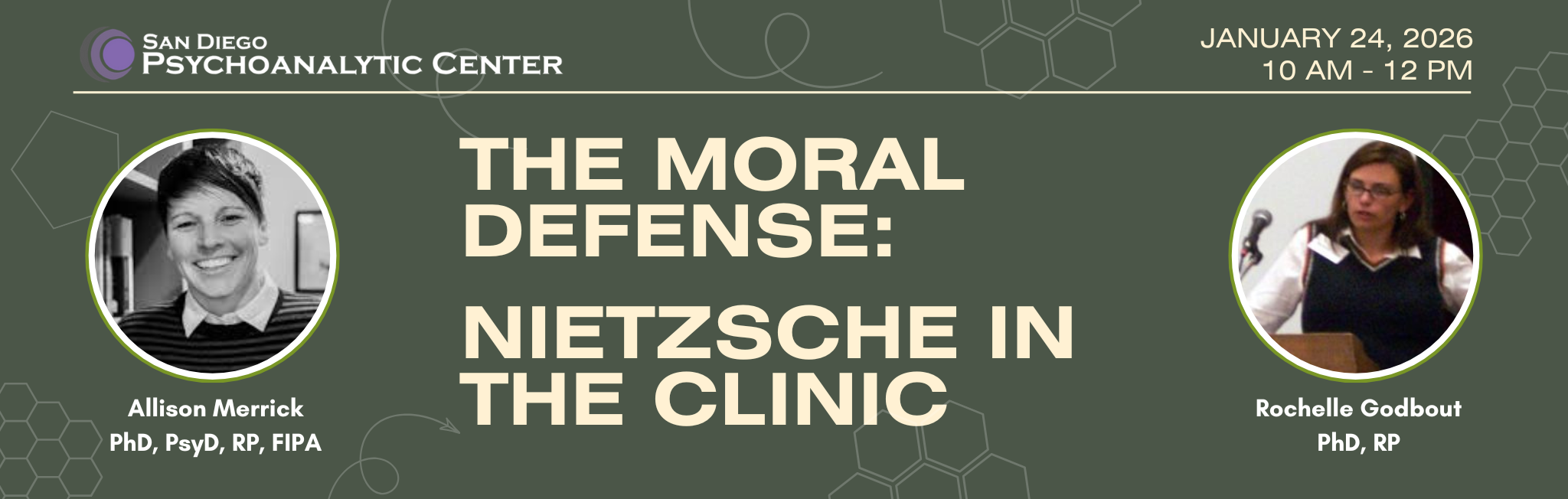
Allison Merrick, PhD, PsyD, RP, FIPA
Allie (Allison) Merrick is Professor of Philosophy at California State University, San Marcos, and a licensed Research Psychoanalyst with a clinical private practice. Allie received her B.A. in History and Philosophy from the University of California, Irvine, her Ph.D. in Philosophy from the University of Southampton, UK, and her Psy.D. and clinical training from the Institute for Contemporary Psychoanalysis, Los Angeles.
As a researcher, Allie is interested in how moral values shape self-understanding, particularly how those values can empower and enliven or constrain and deaden us. Allie is the author of the book Nietzsche on the Methods and Aims of Philosophy: The Seal of Liberation (published by Cambridge University Press last year) and is the co-editor of Nietzsche and Politicized Identities (State University of New York Press) as well as “Shame: Sources and Trajectories,” a special issue of Psychoanalytic Inquiry. Her work has also appeared in The Journal of Nietzsche Studies, the European Journal of Philosophy, and Psychoanalysis, Self and Context. Allie also currently serves on the Steering Committee of the North American Nietzsche Society and the Friedrich Nietzsche Society, UK.
Allie is currently working on two short books: Nietzsche on Genealogy, which will also be published by Cambridge University Press as part of their Cambridge Elements series and Robert Stolorow: A Contemporary Introduction, which will be published by Routledge as part of their Introductions to Psychoanalysis Series.
Rochelle M. Godbout, PhD, RP
Rochelle (Roxy) Godbout is the founder and director of the Sophree Center for Public Philosophy
and a Research Psychoanalyst in private practice in Orange County, California. She has served on
the faculty of a number of colleges and universities as a professor of philosophy and anthropology, most recently as a lecturer of philosophy at California State University, Fullerton. As a founding member of The Malama Collective, and she teaches a variety of courses on the nature of clinical work, theory and practice, and the history of psychoanalysis. She has also served as an affiliated member of The Oxford Consortium of Human Rights. In addition to a variety of work published in peer-reviewed journals and with academic presses, Godbout’s research profile includes Theories of Hope: Exploring Alternative Affective Dimensions of Human Experience (2018). She is currently working on a new manuscript entitled Love and Lovelessness: A New Metapsychology.
---------------------------------------------------------------------------------
Continuing Professional Education Accreditation
The San Diego Psychoanalytic Center (SDPC), is proud to offer CME credit to Physicians, Nurse Practitioners, Psychologists and Social Workers. These CME credits will usually satisfy requirements for Social Worker and Psychologist CEs. However, clinicians should consult their state licensing boards for final approval. Please see the CME/CE credits page for more information.
 |
CMA Accreditation Statement: The San Diego Psychoanalytic Center is accredited by the California Medical Association (CMA, provider #4001214) to provide continuing medical education for physicians. |
AMA Credit Designation Statement: The San Diego Psychoanalytic Center designates this Continuing Education activity for a maximum of 2.0 AMA PRA Category 1 Credit(s)™️. Physicians should claim only the credit commensurate with the extent of their participation in the activity.
 |
CAMFT Accreditation Statement: The San Diego Psychoanalytic Center (Provider #050121) is approved by the California Association of Marriage and Family Therapists (CAMFT) to sponsor continuing education for LMFTs, LCSWs, LPCCs, and LEPs for this activity. The San Diego Psychoanalytic Center maintains responsibility for this program/course and its content. |
BBS Statement: Course meets the qualifications for 10.5 hours of continuing education credit for LMFTs, LCSWs, LPCCs, and/or LEPs as required by the California Board of Behavioral Sciences. Partial credit will not be awarded.
Psychologists: The California Board of Psychology accepts continuing education credit from organizations accredited by the California Medical Association (CMA). Psychologists are responsible for reporting their individual attendance to the Board of Psychology and for ensuring that this activity meets their continuing education requirements.
RN Statement: The San Diego Psychoanalytic Center is approved by the California Board of Registered Nursing, Provider Number CEP#4940, for 2.0 contact hours.
IMPORTANT DISCLOSURE INFORMATION FOR ALL LEARNERS: None of the planners and presenters of this CME program has any relevant financial relationships to disclose.
The San Diego Psychoanalytic Center (SDPC) CME Committee has reviewed the materials for accredited continuing education and has determined that none of the planners and presenters for this activity have relevant financial relationship(s)* to disclose with ineligible companies whose primary business is producing, marketing, selling, re-selling or distributing healthcare products used by or on patients. This activity is not related to the product line of ineligible companies and therefore, the activity meets the exception outlined in Standard 3: ACCME's identification, mitigation, and disclosure of relevant financial relationships. This activity does not have any known commercial support.
*Financial relationships are relevant if the educational content that an individual can control is related to the business lines or products of the ineligible company.
Statement of Commitment: The San Diego Psychoanalytic Center does not discriminate in employment and in its educational programs and activities, including admission or access thereto, on the basis of race, national origin, color, creed, religion, sex, age, marital status, disability, veteran status, sexual orientation, and gender identity.
----------------------------------------------------------------------------------------------------------
The San Diego Psychoanalytic Center is affiliated with the American Psychoanalytic Association (APsA), the International Psychoanalytic Association (IPA), and the Organization of Southern California Psychoanalytic Institutes and Societies.
The San Diego Psychoanalytic Center is a 501(c)(3) nonprofit organization.